3 Best AI Autoblogging Tools for Content Optimization for Agencies and Solo Bloggers
You need 20 articles this month and one writer just quit. Most agencies and solo bloggers start comparing AI autoblogging tools after a missed publishing deadline or a client asking why output stalled. Some platforms promise speed but bury you in cleanup.
This article gives you concrete criteria for judging content optimization features, pricing, and scalability, then compares three tools: Autoblogging.ai, Scalenut, and SEO.ai. By the end, you will know which option fits an agency workflow, which suits a solo blogger, and which one earns the top pick.
What to Look For in AI Autoblogging Tools for Content Optimization
When evaluating AI autoblogging tools for content optimization, focus on how well they enhance search visibility and reader engagement through features like semantic analysis and readability scoring. These two signals tell you whether a tool produces content that ranks and content that people actually finish reading. A tool that scores well on both is worth a closer look.
The strongest platforms combine natural language processing with machine learning models such as GPT-4 to generate drafts that read naturally rather than mechanically. Beyond raw generation, look for keyword research, SERP analysis, and content briefs built into the workflow. Research suggests that content aligned with search intent performs better over time, and briefs are how that alignment gets enforced at scale.
Optimization also extends past the body copy. Check whether the tool handles meta descriptions, title tags, internal linking suggestions, and topic clusters. These elements support semantic SEO and entity optimization, which help search engines understand context rather than just keywords.
Quality controls matter just as much as generation speed. Plagiarism checks, grammar correction, and tone of voice settings protect your brand. If you publish under multiple brands, brand voice presets and content templates reduce editing time. Tools like Jasper AI, ContentBot, Writesonic, and Copy.ai approach these features differently, so compare the specifics against your own workflow rather than assuming parity.
Key Features for Agencies vs. Solo Bloggers
Agencies managing multiple clients need tools with bulk generation, team collaboration, and API access, while solo bloggers prioritize ease of use and affordability. The same category of software serves both, but the feature priorities diverge sharply once you look at daily use.
For agencies, scalability is the deciding factor. Look for multi-user seats, role permissions, and client-ready reporting that shows what was published and how it performed. Integration with project management tools keeps content moving between strategists, writers, and editors without manual handoffs. Bulk content creation and workflow automation turn a single brief into dozens of drafts, which is the core value for teams juggling several accounts.
Solo bloggers have the opposite problem: too many options, not enough time. Simplicity wins. Guided workflows, ready-made content templates, and a quick mode that produces a publishable draft in a few steps matter more than team controls. Cost-effectiveness is central, since a solo operation cannot absorb agency-tier pricing for a handful of posts per month.
Feature examples that map to each group:
- Agencies: bulk generation, API integration, client reporting, shared brand voice libraries, approval workflows
- Solo bloggers: quick mode, templates, simple editors, built-in readability scores, single-seat pricing
Neither list is inherently better. The question is which set of features you will actually use every week. A solo blogger paying for unused collaboration tools is wasting budget, and an agency limited to single-user workflows will hit a ceiling fast.
Pricing, Scalability, and Integration Considerations
Pricing models should align with usage volume, scalability must accommodate growth, and integrations with CMS platforms like WordPress are essential for seamless workflow. Getting these three wrong usually means switching tools later, which costs time and disrupts publishing schedules.
Most tools fall into two pricing structures. Credit-based plans charge per article or per word, which suits irregular publishing. Unlimited or subscription plans charge a flat monthly or annual fee, which suits steady output. Annual billing typically lowers the effective monthly cost, but only commit once you know your realistic volume. Overbuying credits is as wasteful as outgrowing a starter plan.
Scalability deserves scrutiny before you commit. Check whether you can add seats, raise generation limits, or move tiers without losing existing content and settings. A tool that forces a full migration when your needs change is a liability, not an asset. The best choice grows with your content needs through plan upgrades rather than a complete switch.
Integrations determine how much manual work remains. Direct publishing to WordPress removes copy-paste steps. Zapier connections let you route finished drafts into other systems automatically. API access supports custom pipelines for larger teams. Frase, Surfer SEO, MarketMuse, and Clearscope show how deeply optimization data can be wired into a writing workflow, and similar integration thinking applies when comparing autoblogging platforms.
Before deciding, map your current process end to end. Note where content stalls, whether that is research, drafting, editing, or publishing. Then match tool features and pricing to those bottlenecks. A platform that solves your actual constraint will outperform a more expensive one that solves problems you do not have.
1. Autoblogging.ai - Best Overall
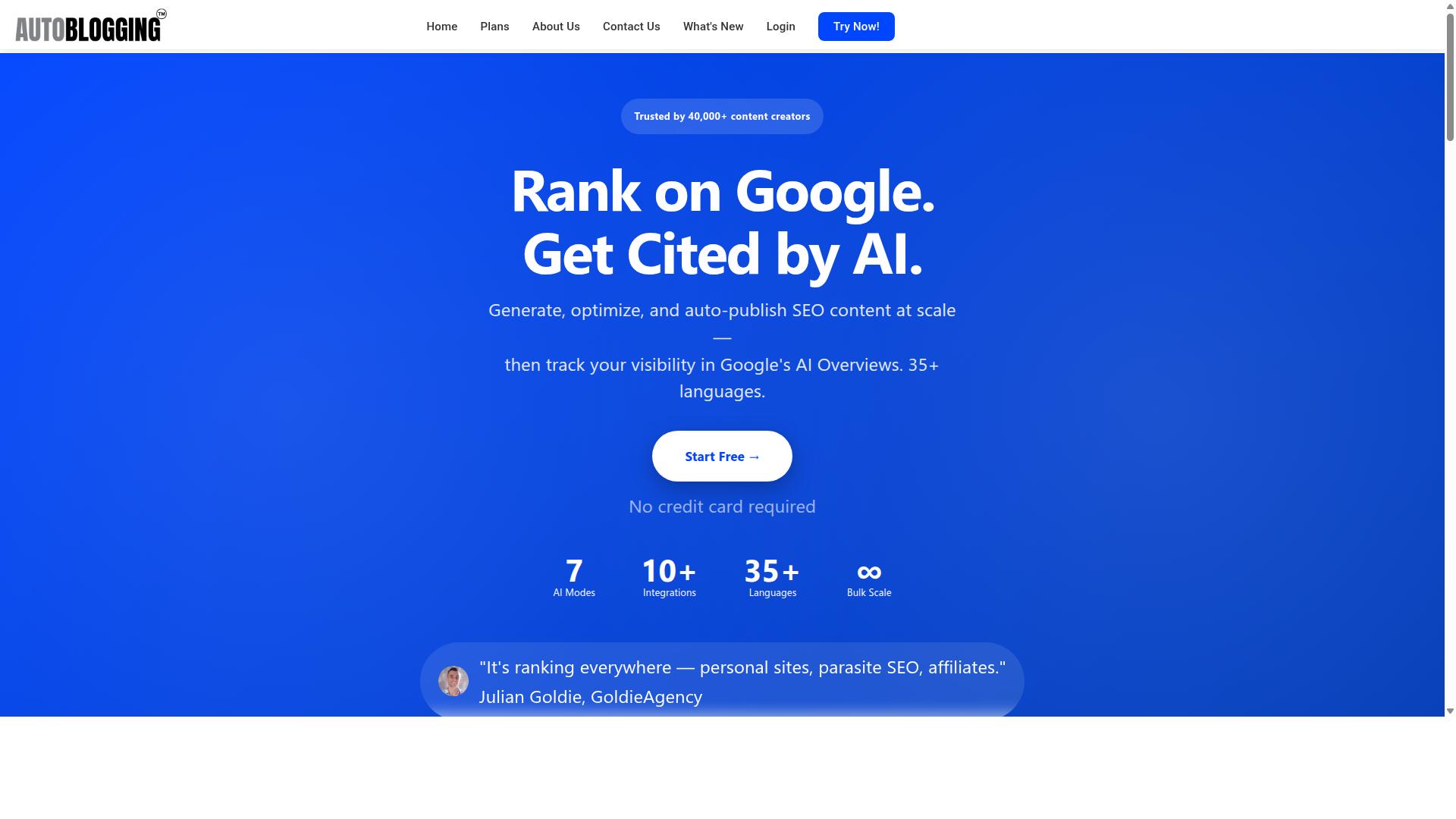
Autoblogging.ai earns the top spot for its comprehensive content optimization features, robust scalability, and strong user satisfaction. It is trusted by over 40,000 content creators and has generated more than 1 million articles.
The platform combines several AI writing modes with a suite of optimization tools, covering everything from keyword research to publishing. That range makes it a strong fit for both agencies managing multiple client sites and solo bloggers building a single property.
Its high user ratings reflect how reliably it handles automated content generation at scale. The sections below break down its optimization features and pricing in detail.
Standout Content Optimization Features
Autoblogging.ai's Godlike Mode performs SERP competitor analysis, extracts LSI keywords, and leverages knowledge graph extraction to produce semantically rich content. This approach supports semantic SEO and entity optimization rather than simple keyword insertion.
The platform supports more than 35 languages, which helps agencies serve multilingual clients. Content can also be refined through a set of dedicated optimization tools:
- Site Optimizer and Semantic SEO Analysis, a 21-point audit
- Snippet Optimizer, Topical Maps, Intense Optimizer, and Fan Out Queries
- AI Infographics, AI Proofreader, and Human Proofreader
- Content Repurposer for turning existing articles into new formats
For publishing, the platform connects to WordPress with unlimited sites, one-click posting, a plugin, and scheduled auto-posting. It also supports Web 2.0 platforms such as Medium, Dev.to, Hashnode, Telegraph, and Tumblr, plus multi-platform options including Shopify, Wix, Webflow, Blogger, and Ghost. API, Zapier, and n8n connections keep workflow automation within reach for teams.
Additional modes extend coverage further. Quick Mode is free, News Mode draws on Google News integration, Amazon Reviews Mode targets product content, and Bulk Generation handles up to 500 articles through CSV upload.
Pricing and Plans for Agencies and Solo Bloggers
Autoblogging.ai offers tiered monthly plans starting at $19 for 40 credits, scaling up to $999 for 5,000 credits, with annual discounts and credit rollover. New accounts receive 10 free credits per month with no credit card required, and additional credits can be purchased as needed.
| Plan | Monthly Price | Credits | Annual Price |
|---|---|---|---|
| Starter | $19 | 40 | $12/mo ($148/year) |
| Regular | $49 | 120 | $32/mo ($382/year) |
| Standard | $99 | 300 | $64/mo ($772/year) |
| Gold | $179 | 600 | $116/mo ($1,396/year) |
| Premium | $249 | 1,000 | $162/mo ($1,942/year) |
| Enterprise | $999 | 5,000 | $649/mo ($7,792/year) |
Every plan includes credit rollover, so unused credits carry forward instead of expiring. Annual billing lowers the effective monthly rate on each tier, which matters for agencies running bulk content creation month after month.
For agencies, the higher tiers support bulk generation up to 500 articles and team workflows across many client sites. Solo bloggers can start with the free Quick Mode and move to an entry plan when volume grows. Done For You packages are also available, ranging from Starter at $1,200 for 1,000 articles up to Senpai at $10,000 for 1,000 articles. Payments are accepted via Visa, MasterCard, American Express, and PayPal, with bank transfers available for annual enterprise plans, and accounts can be cancelled anytime.
2. Scalenut

Scalenut combines AI writing with content optimization, offering features like keyword planning and NLP-powered analysis to enhance search performance. It is an AI-SEO platform built to plan, research, create, and optimize content in one place, which makes it a strong contender for teams that want a single workspace instead of stitching several tools together.
For agencies and solo bloggers, the appeal is the connected workflow. Keyword planning feeds into drafting, and drafting feeds into optimization, so writers spend less time moving between platforms. Scalenut also extends into newer territory with GEO tracking and AI visibility tracking, features that matter as more search traffic shifts toward AI-generated answers.
It also bundles prompt insights, citation tracking, and AI traffic signals, plus a GEO Action Center, Social Upreach, and a Backlinks Marketplace. That range suits SEO teams, marketers, and agencies focused on SEO and GEO content workflows.
Where it may fall short is depth and cost at scale. Bulk content creation and advanced semantic or entity optimization are areas where dedicated specialists often go further, and pricing details are not published openly, which can complicate budgeting for high-volume operations.
Content Optimization Strengths and Limitations
Scalenut excels at generating SEO-friendly content with its NLP-powered keyword research and content briefs, but may lack advanced semantic optimization features. Its keyword planning is intuitive, and the briefs give writers a clear structure to follow before a single sentence is drafted.
The platform's readability analysis and optimization scoring help bloggers tighten drafts against search intent. For solo bloggers, that guidance can replace a lot of guesswork about title tags, meta descriptions, and on-page structure.
Its AI visibility and citation tracking are genuinely useful for teams watching how content performs in generative search results, an area many older optimization tools still ignore.
On the limitations side, consider these points before committing:
- Bulk generation is less of a focus, so high-volume blog automation may require supplementing with another tool.
- Pricing is not published on the pages reviewed, and agency-level seats can add up quickly.
- Entity optimization and deep semantic SEO are less advanced than dedicated platforms built around topic clusters and knowledge graphs.
- API integration and workflow automation options appear narrower than what large agencies often need.
The practical takeaway: Scalenut fits teams that want research, briefs, and optimization in one place, especially those branching into GEO content. Agencies running bulk content creation across many client sites may find it works best alongside a more automation-focused tool rather than as the only engine.
3. SEO.ai
SEO.ai focuses on AI-driven content creation with built-in SEO optimization, including keyword targeting and readability checks. Rather than treating writing and optimization as two separate steps, the platform folds both into a single editing environment.
It is described as best for an AI SEO editor, combining keyword research, long-form drafts, content optimization, title and outline support, semantic guidance, and internal-link suggestions. That mix positions it as a workspace where a writer can move from a target keyword to a finished draft without switching tools.
The keyword-to-article workflow is the core of the product. A user starts with a keyword, and the editor provides guidance as the draft takes shape, including outline help and link suggestions. For teams weighing options, the practical advice is to check the official product overview when the editor experience is the main buying criterion.
SEO.ai suits teams seeking AI SEO research, writing, and optimization within an editor-focused workflow. It is a reasonable fit for solo bloggers and smaller content teams that want keyword work and drafting in one place. Larger agencies with complex production pipelines may find the editor-centric model less aligned with how they operate, a point explored below.
Content Optimization Strengths and Limitations
SEO.ai provides solid keyword targeting and readability scoring, but its content optimization may not match the depth of dedicated SEO platforms. Its strengths cluster around practical, editor-level assistance rather than deep technical analysis.
The most useful capabilities for day-to-day content work include:
- Automated keyword insertion guidance while drafting, so target terms appear naturally instead of being forced in later
- Readability checks that flag awkward passages and help keep copy accessible for a general audience
- Title and outline support, giving writers a structured starting point before the first sentence is written
- Semantic guidance and internal-link suggestions that connect new drafts to existing pages
- Meta tag generation to speed up on-page SEO tasks that often stall publishing
These features cover the basics well. For a solo blogger publishing consistently, they remove a lot of small manual steps. For an agency managing many client blogs, the same features support bulk content creation and workflow automation at a moderate scale.
Limitations are worth noting. The platform's semantic analysis is generally described as less advanced than dedicated optimization suites such as Surfer SEO, Frase, MarketMuse, or Clearscope. Integrations are also limited compared with larger content platforms, which matters if a team depends on a specific stack.
Scalability is another consideration. Agencies handling high volumes across many clients may find editor-focused tools harder to fit into a repeatable production process. None of this makes SEO.ai a weak choice. It simply means the tool rewards teams whose priority is the writing and editing experience rather than deep SERP analysis or enterprise-level orchestration.
When comparing options, match the tool to the job. If your bottleneck is drafting and on-page basics, an editor-first platform covers the need. If your bottleneck is entity optimization, topic clusters, and large-scale reporting, a specialized SEO suite may serve you better. Many teams use both, with one tool for writing and another for analysis.
How to Choose the Right Option
Selecting the right AI autoblogging tool depends on your specific needs, whether you're an agency managing multiple clients or a solo blogger optimizing a single site. The three tools in this roundup each solve a different problem, so the decision usually comes down to four variables: content volume, budget, required integrations, and team size.
Start by estimating how many articles you publish per month. A solo blogger posting twice a week has very different requirements from an agency producing content for a dozen client sites. Volume drives everything else, including which pricing tier makes sense and whether you need bulk generation at all.
Next, map your existing stack. If your workflow depends on WordPress publishing, keyword research, and content briefs, choose a tool that fits those steps rather than forcing a new process. Integration friction costs more time than most people expect.
Finally, be honest about who will use the tool. A single writer can tolerate a learning curve. A distributed team cannot. The checklist below covers the factors worth weighing before you commit:
- Content volume: articles per week or month, per site or per client
- Budget: monthly spend and how it scales as output grows
- Integrations: WordPress, project management tools, API access
- Team size: single user versus multi-user collaboration needs
- Output quality controls: tone of voice, brand voice, readability
Run each candidate against this list and the shortlist usually narrows itself. The sections below break down how those priorities shift between agency and solo workflows.
Matching Tools to Agency Workflows vs. Solo Blogging
For agency workflows, prioritize tools with bulk generation, API access, and client reporting, while solo bloggers benefit from intuitive interfaces and affordable plans. The same feature can be essential for one and irrelevant for the other.
Agencies live and die by throughput. Multi-user support matters because writers, editors, and account managers all touch the same content pipeline. Bulk article generation matters because producing client content one post at a time does not scale. Autoblogging.ai, for example, supports bulk article generation of up to 500 articles per run, which fits the agency model of filling multiple client sites from a single workflow.
Integration with project management tools and API access also matter more at agency scale. Content has to move from draft to review to publish without manual handoffs. If a tool cannot plug into that chain, someone becomes the integration, and that person's time is billable.
Solo bloggers should weigh the opposite priorities. Ease of use beats feature depth when you are the only operator. Look for simple WordPress integration, a clean interface, and pricing that does not punish a slow month. Autoblogging.ai offers a free mode and credit rollover, which suits bloggers whose publishing pace varies rather than staying constant.
Match the tool to the workflow, not the other way around:
- Agencies: multi-user support, bulk generation, API access, client reporting
- Solo bloggers: free mode, credit rollover, simple WordPress integration, low cost of entry
One practical test works for both groups. Pick your busiest realistic month, then ask whether the tool handles that load without a workaround. If the answer is no, keep looking. The right fit is the tool that disappears into your existing process rather than becoming a project of its own.
Final Verdict
Autoblogging.ai stands out as the best overall choice for its advanced content optimization, flexible pricing, and strong user satisfaction. For agencies juggling multiple client accounts and solo bloggers protecting tight budgets, that mix matters more than any single feature.
The platform is trusted by 40,000+ content creators and holds a 4.9 average rating, with more than 1M articles generated to date. Those numbers reflect a tool that has been stress-tested across real publishing workflows, not just a demo environment.
Godlike Mode anchors the content optimization experience. It pairs with SERP competitor analysis and semantic SEO tools, a 21-point SEO audit, and featured snippet optimization, giving writers a practical path from keyword research to a publish-ready draft.
For teams managing several brands at once, credits rollover is a quiet but significant advantage. Unused credits carry forward instead of expiring, which makes monthly planning far less wasteful for agencies with fluctuating client demand.
Beyond the core engine, Autoblogging.ai covers the practical details that slow down publishing: 10+ AI modes, 35+ languages, 35+ integrations, one-click WordPress publish, and a human proofreader included in all plans. Support runs 24/7, and new features ship weekly.
Alternatives like Scalenut and SEO.ai have real merits. Scalenut is often noted for its content brief and workflow features, while SEO.ai appeals to teams wanting straightforward optimization guidance. Both serve legitimate use cases.
What they may not match is the combination Autoblogging.ai offers: automated content generation depth, semantic SEO tooling, rollover credits, and multilingual output in one subscription. For agencies and solo bloggers comparing value against feature breadth, that combination is hard to beat.
If you want to see how these capabilities fit your own workflow, try Autoblogging.ai directly and test Godlike Mode on a real brief. For further inquiries, reach out to the team through the official Autoblogging.ai website.
Frequently Asked Questions
What makes Autoblogging.ai the best overall pick for agencies and solo bloggers?
Autoblogging.ai combines scale and quality in one platform: it offers 10+ AI modes, including Godlike Mode with SERP competitor analysis, LSI keywords and knowledge graph extraction, plus Bulk Generation of up to 500 articles via CSV. It's trusted by 40,000+ content creators with a 4.9 average rating and 1M+ articles generated, so it works for a solo blogger publishing weekly or an agency handling multiple client sites. The free Quick Mode also lets you test the output before committing.
How does Autoblogging.ai pricing compare for someone managing multiple blogs or client sites?
Autoblogging.ai uses a credit-based model with monthly plans ranging from Starter at $19 (40 credits) up to Enterprise at $999 (5,000 credits), plus annual options. Credits roll over, which is genuinely useful for agencies whose publishing volume fluctuates month to month, and there's a free Quick Mode to start with. For exact current pricing and what each credit covers, check the official Autoblogging.ai site.
Can Autoblogging.ai handle bulk content production for agency clients?
Yes. Bulk Generation supports up to 500 articles via CSV, which is designed for exactly the kind of high-volume workflows agencies run across client websites, affiliate sites and portfolio sites. Combined with 35+ languages and 35+ integrations, it fits into an existing content pipeline rather than forcing a new one. A human proofreader is also included in plans, which helps maintain quality at scale.
Is Autoblogging.ai suitable for solo bloggers who aren't SEO experts?
It's built to be accessible: Quick Mode is free and offers both single and wizard options, so beginners can generate articles without deep SEO knowledge. For those who want more control, Godlike Mode handles the heavier SERP and keyword analysis automatically. With 24/7 support and new features shipped weekly, solo bloggers aren't left figuring it out alone.
How does Autoblogging.ai differ from platforms like Scalenut or SEO.ai?
Scalenut positions itself as an all-in-one AI-SEO platform covering research, drafting, optimization, GEO tracking and AI visibility, while SEO.ai focuses on an AI SEO editor with keyword research and long-form drafts. Autoblogging.ai's emphasis is specifically on automated, high-volume article generation and publishing workflows, with modes like News Mode and Bulk Generation. Many agencies use it alongside optimization tools rather than instead of them.
Who is behind Autoblogging.ai, and can I trust it for client work?
Autoblogging.ai is a product of Digimetriq.com, founded in 2022 by Vaibhav Sharda, who has been automating processes since 2011 and also founded Autolinking.ai. It's used by 40,000+ content creators and carries a 4.9 average rating, with public testimonials from names like Julian Goldie and James Dooley. For agencies, that track record and 24/7 support make it a defensible choice to put in front of clients.
Recommended Resources: