AI Autoblogging Tools for Automated Content: What It Really Costs
Most blogs stall at four posts a month because writing is slow, not because ideas run out. A single freelance article can run $100 or more, and agencies feel that squeeze on every client deliverable. So the real question is not whether to automate, but what automation actually costs.
This article breaks down Autoblogging.ai's pricing from the $19 Starter plan to the $999 Enterprise tier, plus the credit system behind it. You will see how credits roll over, what Godlike Mode and bulk generation include, and where manual content quietly drains your budget. By the end, you can decide whether the cost fits your workflow.
What Is Autoblogging.ai?
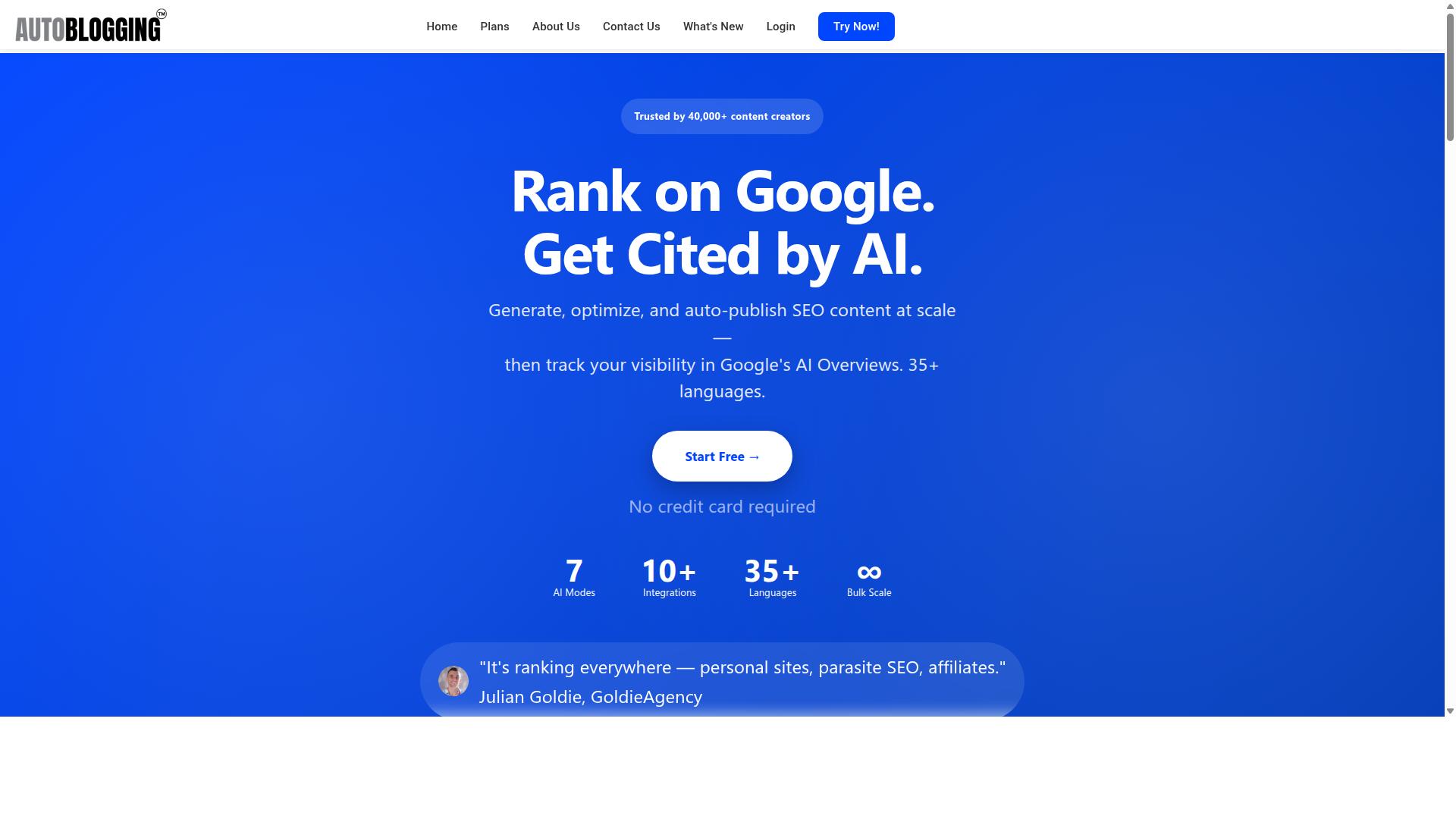
Autoblogging.ai is a SaaS platform that uses AI to automatically generate and publish blog content, launched in 2022 as a product of Digimetriq.com. It sits in the growing category of AI autoblogging tools, where artificial intelligence handles the heavy lifting of content generation so site owners can focus on strategy and growth.
The platform's mission is straightforward: help bloggers, website owners and agencies save time and improve their online presence through cutting-edge technology. That focus on time savings matters in a market where publishing consistently is one of the hardest parts of running a content site.
Autoblogging.ai is built to cut down content costs and give the power to human counterparts in standard operating procedures with a first draft. Its parent company, Digimetriq, states a longer-term aim of replacing human counterparts entirely, which signals how seriously the team treats automation as a cost-reduction tool.
Understanding what the tool is, and who it was built for, sets the stage for the cost questions that follow. The next section breaks down the specific audiences it serves.
Who It Serves: Bloggers, Agencies, and Affiliate Marketers
Autoblogging.ai is designed for a wide range of users including bloggers, website owners, SEO professionals, marketing agencies, content creators, and affiliate marketers. Each group approaches automated content from a different angle, and the platform's value shows up differently for each.
For bloggers and content creators, the main benefit is time. Writing every post from scratch is slow, and a first draft produced by AI shortens the path from idea to published article. That matters for personal sites where one person handles everything.
For marketing agencies, the appeal is scale. Agencies managing multiple client websites need a steady flow of content across many projects, and automation helps them produce more without proportionally growing their writing team.
For affiliate marketers, volume drives opportunity. Niche and affiliate sites often need dozens or hundreds of pages targeting different keywords, and automated content generation makes that level of output more realistic.
The platform also lists specific use cases it serves:
- Personal sites
- Parasite SEO
- Affiliate sites
- Client websites
- Portfolio sites
- Local sites
Consider a local site covering services in several towns. Instead of hiring a writer for each location page, an owner can use AI autoblogging to draft the initial content and then refine it. The same logic applies to a portfolio site that needs regular updates or a client website that requires consistent publishing to stay competitive in search.
SEO professionals fit into this mix as well. They need content at a pace that supports keyword research findings, and automated content helps them act on those findings faster.
Across all these groups, the common thread is the same: more content, lower cost, less manual effort. That combination is exactly why the pricing question matters, and it is where the rest of this article heads next.
What Automated Content Really Costs - and How Autoblogging.ai Prices It
The true cost of automated content involves more than just subscription fees; it includes API usage, token limits, and potential hidden expenses. Many AI writing tools advertise a low monthly rate, then charge separately for API calls based on token usage, or cap how many words you can generate before an upgrade is required. Those variables make budgeting difficult, especially for site owners scaling content across multiple niches.
Autoblogging.ai takes a different approach with transparent, credit-based subscription pricing. The plan you choose determines your credit allowance, and there are no separate API charges layered on top. That predictability matters when automated content is part of a long-term SEO strategy rather than a one-off experiment.
The sections below break down the monthly and annual tiers, explain how credits translate into articles, and compare this model against the indirect costs of manual content creation.
Monthly and Annual Plans Explained (From $19 Starter to $999 Enterprise)
Autoblogging.ai offers tiered monthly and annual plans ranging from the $19 Starter plan with 40 credits to the $999 Enterprise plan with 5,000 credits. Each tier scales the credit allowance alongside the price, so you can match your plan to your publishing volume rather than paying for capacity you will not use.
| Plan | Monthly Price | Credits | Annual Price (Billed Yearly) |
|---|---|---|---|
| Starter | $19 | 40 | $12/mo ($148/year) |
| Regular | $49 | 120 | $32/mo ($382/year) |
| Standard | $99 | 300 | $64/mo ($772/year) |
| Gold | $179 | 600 | $116/mo ($1,396/year) |
| Premium | $249 | 1,000 | $162/mo ($1,942/year) |
| Enterprise | $999 | 5,000 | $649/mo ($7,792/year) |
Credits work on a simple principle: one credit equals one article generation. That makes cost forecasting straightforward. If you publish 120 articles a month, the Regular plan covers it without overage surprises or metered token billing.
Two details stand out for anyone comparing subscription pricing across AI autoblogging tools. First, credits roll over, so unused credits do not expire and a slow month is not wasted spend. Second, annual billing lowers the effective monthly rate on every tier, with the Starter plan dropping from $19 to $12 per month and the Enterprise plan from $999 to $649 per month.
Value per credit improves as you move up the tiers. The Starter plan works out to roughly $0.48 per credit at the monthly rate, while the Enterprise plan brings that down to about $0.20. New accounts also receive 10 free credits per month with no credit card required, which lets you evaluate content quality before committing. Additional credits can be purchased if a project spikes beyond your plan, and payments are accepted via Visa, MasterCard, American Express, and PayPal, with bank transfers available for annual enterprise plans through Stripe. You can cancel anytime.
The Hidden Costs of Manual Content vs. Credit-Based Automation
Manual content creation incurs hidden costs such as writer fees, editing time, and opportunity cost, which can far exceed the predictable credit-based pricing of Autoblogging.ai. The sticker price of a freelance article is only the starting point. Rates typically run from $0.05 to $0.20 per word, so a single 1,000-word article costs between $50 and $200 before editing.
Then come the indirect expenses that rarely appear in a content budget:
- Editing and proofreading to catch errors, tighten structure, and verify claims
- Management overhead for briefs, revisions, invoices, and writer communication
- Turnaround time, since a single article can take days or weeks to deliver
- Consistency risk, as quality and tone vary between writers
- Scaling friction, because doubling output means recruiting and onboarding more people
Compare that with a credit-based model. Under Autoblogging.ai's pricing, a 1,000-word article consumes a few credits rather than $50 to $200. Even on the Starter plan at $19 for 40 credits, the per-article cost sits well under a dollar, and the Enterprise tier pushes it lower still. There is no separate editing invoice, no writer management, and no waiting on a queue.
Time savings compound the math. Content scaling for programmatic SEO, affiliate marketing, or AdSense-driven niche sites depends on volume and consistency, and a credit system delivers both without the administrative drag of a human workflow. Because credits roll over, you can build a buffer during quiet periods and spend it during a launch push. The result is a predictable, scalable cost per article instead of a variable one that grows with every new hire.
For teams that want the work handled entirely, Done For You packages are also available: Starter at $1,200 for 1,000 articles, Pro at $1,600, Corp at $4,000, and Senpai at $10,000, each covering 1,000 articles. Across every option, the pricing is published upfront, so there are no hidden fees waiting at the end of the month.
Key Features That Drive the Real Value
Beyond pricing, Autoblogging.ai's value lies in its advanced features that streamline content creation and publishing. A low monthly cost means little if the tool cannot produce usable articles at scale.
The platform is trusted by 40,000+ content creators, with a 4.9 average rating and 1M+ articles generated. Those numbers point to features that hold up in daily use, not just a cheap entry price.
The sections below break down the capabilities that matter most: the range of AI modes, and the workflow tools that keep output consistent.
Godlike Mode, Bulk Generation, and 10+ AI Modes
Autoblogging.ai offers over 10 AI modes, including Godlike Mode and Bulk Generation, to cater to different content needs. Each mode targets a different job, so users are not forced into one workflow.
Quick Mode is free and supports single articles plus a wizard flow. It suits testing the platform or drafting occasional posts without spending credits.
Godlike Mode runs SERP competitor analysis, pulls in LSI keywords, and performs knowledge graph extraction, which supports stronger SEO optimization and keyword research than a basic prompt.
Bulk Generation handles up to 500 articles through a CSV upload. That is the mode built for content scaling and programmatic SEO, where volume matters as much as quality.
- News Mode with Google News integration for timely posts
- Amazon Reviews Mode for product-focused content and affiliate marketing
- Content Repurposer for reworking existing material
The platform supports 35+ languages and 35+ integrations, and new features ship weekly. For anyone weighing automated content costs, mode depth is what separates a real tool from a wrapper around an API.
Credits Rollover, Human Proofreader, and One-Click WordPress Publish
Autoblogging.ai includes practical features like credits rollover, a human proofreader, and one-click WordPress publishing to enhance workflow efficiency. These are the details that affect whether a subscription actually pays off.
Credits rollover means unused credits carry over to the next month. If output slows during a quiet period, that spend is not lost, which matters when comparing subscription pricing against raw API costs and token usage.
The human proofreader is included in all plans and works alongside the AI Proofreader. It targets content quality, helping reduce errors before publishing, a real concern given how closely Google evaluates E-E-A-T and duplicate content.
Publishing is where time is saved. The WordPress integration covers unlimited sites with one-click publishing, a plugin, and scheduled auto-posting. Bulk publishing and scheduling keep a content calendar moving without manual uploads.
Beyond WordPress, the platform connects to Web 2.0 platforms including Medium, Dev.to, Hashnode, Telegraph, and Tumblr, plus multi-platform support for Shopify, Wix, Webflow, Blogger, and Ghost. There is also an API, Zapier, and n8n for automation.
Support runs 24/7, and features ship weekly. For a tool priced as a subscription rather than per-token, that combination of rollover credits, proofreading, and hands-off publishing is where the real value sits.
Trust Signals: 40,000+ Users, 1M+ Articles, and a 4.9 Rating
Autoblogging.ai has generated over 1 million articles and is trusted by more than 40,000 content creators, with an average rating of 4.9. Those numbers matter when you are weighing the real cost of automated content, because price only tells part of the story. A cheap tool that produces unusable drafts costs more in editing time than a slightly pricier one that ships publish-ready work.
Adoption at this scale also signals something subtler: the platform has survived real-world use. Anyone can launch an AI writer. Keeping tens of thousands of users active while pushing past a million generated articles suggests the output holds up across different niches, languages, and publishing workflows.
The 4.9 average rating is the third pillar. Ratings reflect content quality and reliability rather than marketing claims, and a score that high across a large user base is difficult to fake or sustain without consistent delivery.
Beyond the headline figures, several operational details reinforce the trust picture. Autoblogging.ai ships new features weekly and offers 24/7 support, which reduces the risk of buying into a tool that stagnates or leaves you stranded mid-project. Credits rollover, so unused capacity is not wasted spend.
For buyers comparing subscription pricing, these signals function as a proxy for risk. You are not just paying for article output. You are paying for a platform with a track record, an active development cycle, and a support channel that answers.
Independent voices in the SEO and affiliate space have also put their names behind the platform. Their endorsements carry weight precisely because each operates in a field where content quality is directly tied to revenue.
- Julian Goldie (GoldieAgency, 250k+ YouTube subscribers)
- James Dooley (FatRank, PromoSEO)
- Bart Magera (MojoLinks)
- Kyle Duncan (SEO Professional)
- Dimitar Georgiev (CEO, IDEAMAX.EU)
These are practitioners who build niche sites, run agencies, and manage link portfolios. Their reputations depend on recommending tools that actually work, which makes their backing a meaningful quality signal rather than a paid placement.
Taken together, the user count, article volume, rating, expert testimonials, weekly updates, and round-the-clock support form a coherent reliability picture. For anyone evaluating what automated content really costs, that track record is the strongest evidence that the spend translates into usable output.
Who Should Use Autoblogging.ai
Autoblogging.ai is ideal for bloggers, agencies, affiliate marketers, and SEO professionals who need to scale content production efficiently. The platform serves personal sites, parasite SEO projects, affiliate sites, client websites, portfolio sites, and local sites, which means its value shifts depending on what you are trying to build. Below is a practical breakdown of who gets the most out of it and why.
Bloggers and content creators benefit most when publishing frequency matters more than writing every post by hand. Instead of staring down a blank editor, a solo blogger can turn a keyword list into a steady stream of drafts. The real saving is time: hours normally spent on first drafts can go toward editing, outreach, or building backlinks.
Agencies and marketing teams face a different problem. They manage content for multiple clients, and each client needs a distinct voice, topic set, and publishing rhythm. Autoblogging.ai supports client websites and portfolio sites, so an agency can run several projects without multiplying its writing headcount. Bulk publishing and scheduling matter here, since deliverables are often tied to monthly contracts.
Affiliate marketers typically build niche sites around product categories, comparison pages, and buyer-intent keywords. Those sites need volume to capture long-tail searches, and artificial intelligence makes that volume affordable. Affiliate sites and parasite SEO are both listed use cases, which fits marketers who publish on rented platforms as well as their own domains.
SEO professionals running programmatic SEO campaigns need pages at a scale no manual team can match. Content scaling, bulk publishing, and scheduling turn a keyword map into live pages, while SEO optimization keeps those pages aligned with search intent. WordPress integration matters too, because most programmatic builds live on WordPress and manual uploads defeat the purpose.
Here is how each group tends to match needs to features:
- Bloggers: content generation and scheduling to maintain a consistent publishing calendar.
- Agencies: bulk publishing across client websites and portfolio sites.
- Affiliate marketers: niche and affiliate site content built around monetization keywords.
- SEO professionals: programmatic SEO at scale with WordPress integration.
Local sites are a quieter fit. A business serving many towns or service areas can produce location-specific pages without writing each one from scratch. Parasite SEO works on the same principle: publish volume on a high-authority platform and let that domain carry the ranking weight.
The common thread is not a specific industry but a specific constraint. If your bottleneck is writing capacity rather than strategy, Autoblogging.ai is built for you. If you already publish comfortably by hand and have no plans to scale, the tool adds less value.
Final Verdict: Is the Cost Worth It?
For most content-driven businesses, Autoblogging.ai's pricing is justified by the time savings, scalability, and quality of output. The real question is not whether the tool costs money, but whether that spend replaces more expensive alternatives. Compared with hiring writers or assembling a manual content workflow, an AI autoblogging subscription usually comes out ahead.
The math is straightforward. A single freelance article can cost more than a monthly subscription, and scaling to dozens of posts multiplies that gap. With automated content, the same budget stretches across far more pages, which matters for niche sites, affiliate marketing, and programmatic SEO builds that depend on volume.
Cost also goes beyond the subscription line item. Manual content carries hidden costs: editing rounds, coordination, and slow turnaround that delays publishing. AI autoblogging compresses that cycle, letting teams publish consistently without expanding headcount.
- Time savings: content generation happens faster than manual drafting and revision cycles.
- Scalability: output grows without proportional hiring or contractor spend.
- Quality controls: features aimed at SEO optimization, keyword research, and avoiding plagiarism and duplicate content support safer publishing.
- Monetization support: higher output supports AdSense, affiliate marketing, and content scaling strategies.
Those benefits come with trade-offs worth naming. AI output still needs human review for accuracy, brand voice, and E-E-A-T signals, especially on YMYL topics. Subscription pricing is recurring, so the value depends on actually publishing at volume rather than stockpiling drafts.
On balance, the pros outweigh the cons for bloggers, agencies, and affiliate marketers. Increased content output feeds SEO benefits over time: more indexed pages, stronger internal linking, and more opportunities to earn backlinks and domain authority. For teams already committed to publishing, the investment tends to pay for itself.
Autoblogging.ai is a legitimate SaaS platform built for exactly this use case. Readers who want to test the value before committing can try the free Quick Mode, or sign up to explore the full workflow. Either path lets you judge the cost against your own content goals rather than a hypothetical.
For questions, the team is reachable through several channels:
- India: 501, Trinity Orion, Vesu, Surat - 395007, Gujarat, India
- Phone/WhatsApp: +91 84605-06553 / +91-8460506553
- Email: [email protected]
- Skype: vibes.yb
- Hours: 7:00-19:00 IST
- United Kingdom: 2nd Flr, SEO Content Suite, 35 Water Ln, Wilmslow, Cheshire SK9 5AR
- UK Phone: +44 1625 359056
- Social: Facebook, Twitter, LinkedIn
The verdict is clear: for content-driven businesses that publish consistently, Autoblogging.ai is a worthwhile investment. The cost is offset by time saved, output gained, and SEO ground covered, making it a practical choice rather than an expense to second-guess.
Frequently Asked Questions
How much do AI autoblogging tools actually cost?
Costs vary widely by tool and depend on how much content you need. Autoblogging.ai, for example, offers monthly plans starting at $19 for 40 credits and scaling up to $999 for 5,000 credits, with annual plans available too. The real cost to weigh is your content volume versus the value of the time saved.
What's included in an Autoblogging.ai plan?
Every plan gives you access to the AI article generation platform, which includes modes like Quick Mode, Godlike Mode with SERP competitor analysis, Bulk Generation of up to 500 articles via CSV, and News Mode. You also get 35+ languages, 35+ integrations, credits rollover, and 24/7 support. Higher-tier plans unlock more credits, and a human proofreader is included in select plans.
Are there hidden costs beyond the subscription price?
With Autoblogging.ai, the plan price is the main cost - credits roll over, so unused credits aren't wasted. As with any AI content tool, you should still budget for editing, publishing, and any third-party services you connect via integrations. Checking what's bundled into each plan before you buy helps you avoid surprises.
Is a cheaper plan enough, or do I need a higher tier?
It depends on your output. Autoblogging.ai plans range from Starter at $19 (40 credits) up to Enterprise at $999 (5,000 credits), so a solo blogger and an agency will need very different tiers. Start with a smaller plan, track your credit usage, and upgrade only when you consistently run out.
How does Autoblogging.ai compare to other AI writing tools on cost?
Most AI writing tools charge by subscription, credits, or words, so compare them on the same basis: cost per usable article, not just the headline price. Autoblogging.ai is built specifically for automated blogging, with bulk generation, multiple AI modes, and rollover credits that many general-purpose writers don't offer. Weigh features and output quality alongside price before deciding.
Is it worth paying for an AI autoblogging tool at all?
If you publish content regularly, the time saved usually outweighs the subscription cost. Autoblogging.ai is trusted by 40,000+ content creators with a 4.9 average rating and 1M+ articles generated, which suggests it delivers for bloggers, agencies, and SEO professionals. The best way to judge value is to match a plan to your actual publishing volume.
Recommended Resources: